Receipts attached 6 sources
Sources
-
Other source
Ghost on the Thunderbolt
Jennifer Huberdeau reproduces and describes the 1939 newspaper accounts, Saunders legend, 1965 clipping rediscovery and Belanger quote.
-
Other source
Spirit of the Thunderbolt
Durwin analyzes the newspaper photographs and the uncertainty over Saunders; republished on his blog in 2010.
-
Other source
Mt. Greylock CCC ski trails history
Records the Thunderbolt race revival in 2010 and trail history.
-
Other source
The Old Coot of Bellows Pipe Trail
Podcast episode confirms the legend continued in a modern telling.
-
Other source
As bald as a coot
Documents the 1430 phrase.
-
Other source
Coot word history
Search excerpt confirms the 1766 figurative usage; source page blocked direct extraction.
Limits
The Saunders biography and purported 1939/1979 sightings are folklore reported by later writers, not established historical or paranormal facts. The 1939 clippings were described and reproduced by Huberdeau and Durwin, not independently retrieved from an archive.
Corrections
No correction notes have been added for this article.
Call a man an old coot and you have insulted him twice. You have called him old, and you have called him a fool. The word began with a water bird, black with a white shield above its bill. “Bald as a coot” appears in a 1430 poem. By 1766, “coot” could mean a silly person. On Mount Greylock, though, Old Coot is a proper name, and the man who carries it is a ghost.
At least, that is how the story goes. The surviving accounts tell us much more about how Adams and North Adams told the tale than about whether William Saunders, the man in it, ever lived.
The man in the story
In the version printed by the North Adams Transcript in January 1939, Saunders was a farmer who left his wife, Belle, and their two children to fight for the Union. He was wounded. Word of him stopped. After a year without news, Belle married a farmhand named Milton Cliffords.
Then Saunders came home. The war had left him so thin that nobody recognized him. His wife had a new husband, and another man owned the farm. Rather than announce himself, the story says, he bought a patch of land on Greylock, lived alone and hired himself out to nearby farms. Sometimes he worked on his old farm and ate beside children who did not know he was their father. Hunters eventually found him dead in his shack, with discharge papers that gave him a name.
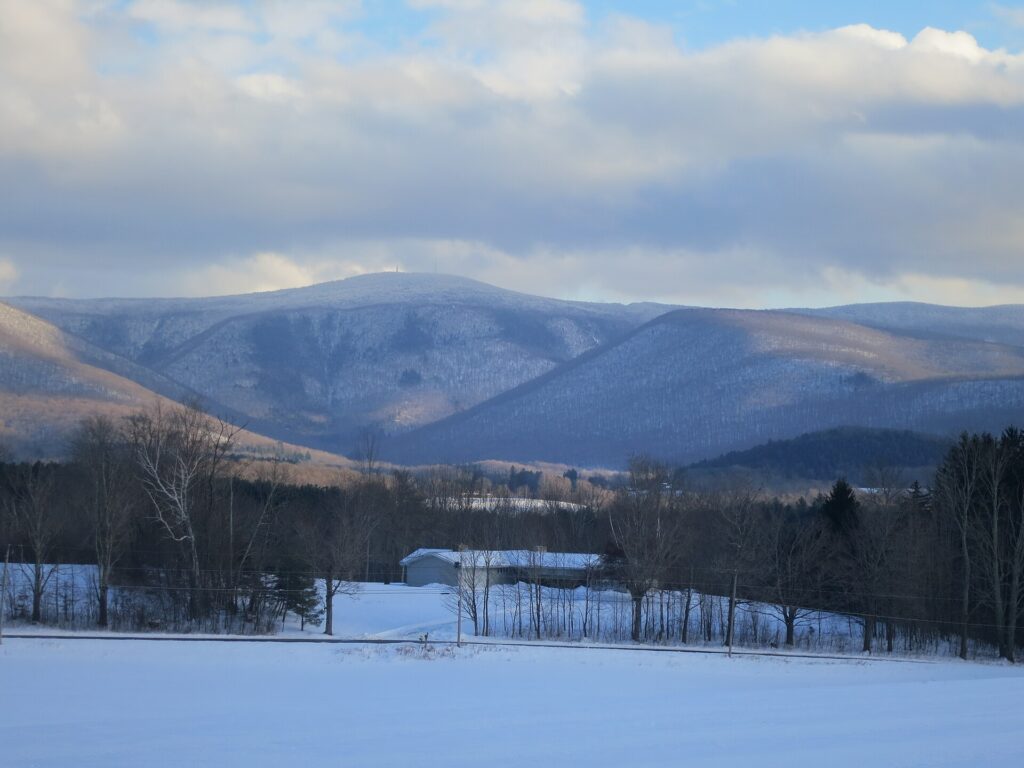
Local writer Joe Durwin called Old Coot the “Enoch Arden of the Berkshires,” after Tennyson’s returning sailor who finds his wife remarried and keeps his identity to himself. The ghost is said to haunt the lower reaches of the Thunderbolt and Bellows Pipe trails, walking toward an overlook above the old Bernard Farm during the last two weeks of January.
A ghost in the race paper
The earliest known printed account appeared in the Transcript on January 19, 1939, just before a Massachusetts downhill championship on the Thunderbolt. It warned spectators, with a conspicuous wink, that Old Coot might appear near the finish. When a lack of snow postponed the race, photographer P. Randolph “Randy” Trabold and companions went looking for him.
In the account published with a photograph on January 27, Trabold said a ragged man in a Civil War uniform emerged from the woods and greeted him with “Ski Heil!” Trabold answered coolly. He reached for his camera; the stranger ran, faded and disappeared. The picture made the paper. It also gave the ghost something most ghosts lack: a publicity photograph.
Jennifer Huberdeau’s account reproduces the old newspaper story and describes how a reader found the clipping in a cookbook in 1965, prompting Trabold to tell it again. Another Transcript photographer produced a second purported ghost image in 1979. Durwin, who examined those photographs, thought they were made by laying one negative over another. He saw the whole affair as a piece of good-humored promotion for the ski race.
That is a persuasive reading, not a proven account of who invented Saunders. Durwin found no matching prewar North Adams record for the man described in the legend. Huberdeau notes that the farm moves between North Adams and Bob’s Hill in different tellings, while the month in which hunters found him also changes. Those slips do not settle whether a real person inspired the story. They do tell us not to present its biography as established local history.
Why Old Coot stayed
The racing did not end forever in the 1950s. Local skiers revived the Thunderbolt for a 75th-anniversary race in 2010. Old Coot, meanwhile, traveled from newspaper to cookbook to local-history writing and, eventually, a New England Legends hike and podcast.
Jeff Belanger, the podcast’s co-host, told Huberdeau that Old Coot is “the epitome of devotion wrapped in a ghost story.” That is why the tale works even if its newspaper photograph was a joke. Saunders, as imagined in 1939, sees the life he left behind and refuses to disturb it. The bird gave us a word for a fool. The ghost turns the insult around.
There is room for him in a town where people leave, return and find that other lives have gone on without them. And there is a smaller reason to keep the story: read Trabold’s account again and notice who is rude. The ghost opens with a cheerful greeting. The living man gives him the cold shoulder. If Old Coot appears on the Thunderbolt next January, someone ought to say hello back.