Receipts attached 5 sources
Sources
-
Other source
President McKinley in Adams
McKinley's visits and the Plunkett connection.
-
Other source
Unveiling of the McKinley statue, Adams, Mass., October 10, 1903
Contemporary account of the unveiling.
-
Other source
Adams Historical Society Brings Plunketts to Life
Plunkett mansion is now Town Hall.
-
Other source
McKinley Tariff
House vote 164-142 on May 21, 1890; signed October 1, 1890.
-
Other source
Why McKinley? historical marker
Marker text; gives a differing dedication date.
Limits
Local history. Sources disagree on some details: the statue's dedication is October 10, 1903 in the Adams Historical Society and contemporary accounts (one marker says October 19); the arm gesture recalling the tariff speech is local tradition; the mills' four expansions come from an Adams Historical Society newsletter.
Corrections
No correction notes have been added for this article.
A president who looks like he is directing traffic
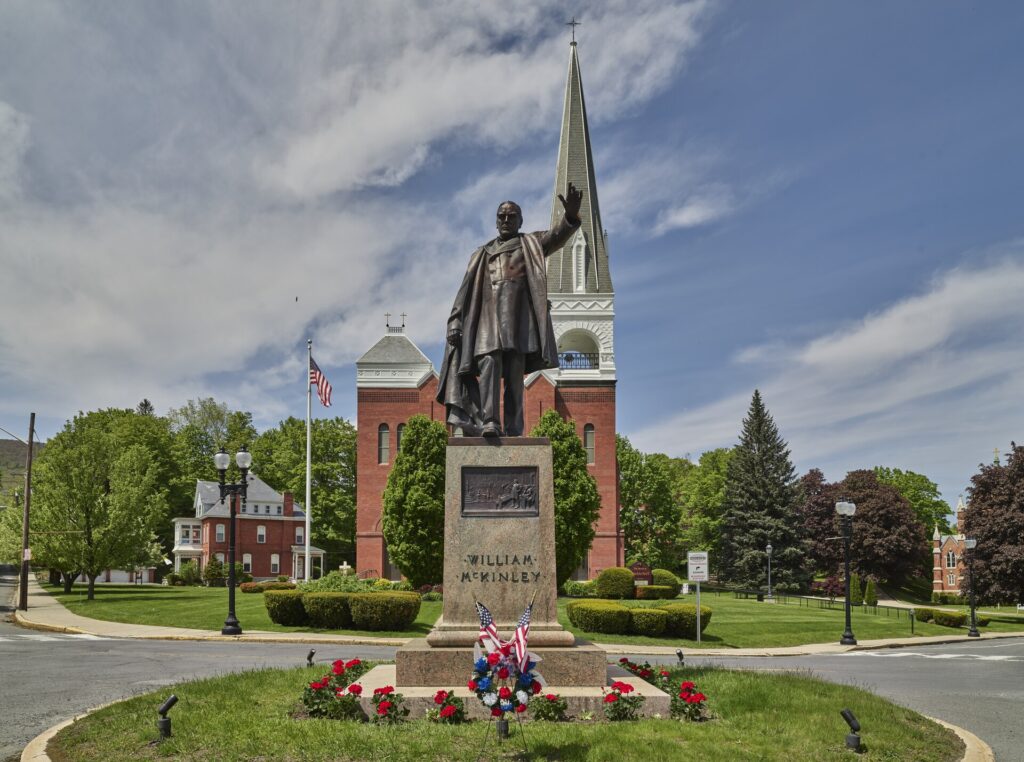
Drive into Adams from the north and you meet William McKinley at the rotary. He stands about eight feet tall in bronze on a granite pedestal, with his left arm thrown out to the side. Visitors have joked for generations that he is waving at passing cars, or directing them. The gesture is older, and more deliberate, than it looks.
By local tradition, the pose freezes a moment from McKinley’s years in Congress: the Ohio representative on his feet in the House, arguing for the tariff bill that would carry his name. The front plaque on the pedestal removes most of the doubt. It shows McKinley addressing the House on the measure that became famous under his name. A local historical timeline says the raised hand is “supposed” to echo a gesture from that speech, so treat the story as a strong tradition rather than a documented fact. Either way, the statue honors a man best known in Adams for one thing: the tariff.
Who built it, and when
McKinley was shot at the Pan-American Exposition in Buffalo on September 6, 1901, and died on September 14. Adams moved quickly. The town commissioned the New York sculptor Augustus Lukeman, and the Plunkett family started a fund to pay for the memorial, with contributions also coming from schools, churches, and local manufacturers. The statue was unveiled on October 10, 1903, a little more than two years after the assassination.
It was one of the biggest days in the town’s history. A special train brought crowds from North Adams, trolley cars ran full, and the governor and lieutenant governor attended. A decorated platform stood on the terraces of the Adams Free Library, whose cornerstone McKinley had laid himself six years earlier. The spot is now McKinley Square, and in 2003 the town held a rededication on the statue’s hundredth anniversary.
Four bronze tablets decorate the pedestal. The front tablet shows the tariff speech. The west side shows McKinley as a young commissary sergeant at Antietam, and the east side shows his first inauguration in March 1897. The rear carries words from his last speech, at Buffalo, about concord rather than conflict and the victories of peace rather than war. That last choice turns out to matter, as we will see.
The bill behind the bronze
McKinley chaired the House Ways and Means Committee when the Tariff Act of 1890 took shape. The House passed it 164 to 142 in May, and President Benjamin Harrison signed it on October 1, 1890. It raised average import duties from about 38 percent to roughly 49.5 percent, and it earned McKinley the nickname “Napoleon of Protection.” It was not a simple across-the-board increase. Rates rose on many manufactured goods while sugar and coffee went on the free list, and the Senate added a reciprocity provision.
Voters were unimpressed. Prices rose within weeks of the law taking effect, and many Americans saw the act as a gift to wealthy industrialists. In the November 1890 elections House Republicans lost 93 seats, and McKinley lost his own, partly because of unfavorable redistricting. The Democrats later replaced much of the law with the Wilson–Gorman Tariff of 1894. The politics were bad. For mill towns like Adams, the economics looked different.
The Plunketts of Adams
William C. Plunkett came to Adams from Lenox in 1829 to manage a textile business and, within a few years, bought out the other shareholders. He went on to serve as lieutenant governor of Massachusetts in 1854 and 1855, and he died in 1884. Five years later, in 1889, two of his sons, William B. and Charles T. Plunkett, organized the Berkshire Cotton Manufacturing Company.
The brothers made a smart bet on fine cotton goods, such as lawns and organdies, at a time when other Adams mills were losing ground. They also found a friend in McKinley. He and William B. Plunkett became close, and McKinley made three visits to Adams that were tied to the family’s business and civic life:
- October 1892: As governor of Ohio, he took part in the dedication ceremonies for Berkshire Mill No. 2, before a crowd reported at about 3,000, followed by a ball and a concert.
- September 1897: Newly inaugurated as president, he returned with members of his cabinet, stayed for several days at the Plunkett mansion on Park Street, and laid the cornerstone of the Adams Free Library.
- June 1899: He came back to lay the cornerstone of Mill No. 4, cutting the trip short because his wife was ill.
The mansion where he slept is now Adams Town Hall.
How the Plunketts benefited
According to the Adams Historical Society, the Plunketts took advantage of the price protection in the McKinley Tariff to expand four times over the following eleven years. The company grew into the largest mill operation Adams ever had. By 1917 it was capitalized at $2.5 million, with more than 260,000 spindles and 6,500 looms, which made it one of the largest cotton textile companies in the world. By 1929 it was considered the largest fine-goods mill in New England.
The money did not stay in the family’s pocket alone. Mill wages and mill growth drove the building of Park and Summer Streets, new schools and churches, and housing for a rapidly growing, multi-ethnic workforce. The family’s name is still on a school, on the library fund, and on the hospital William B. Plunkett helped make possible in 1918.
Still, it would be too neat to say the tariff made the Plunketts rich. The firm’s success also rested on its fine-goods strategy and on the scale it reached. Economists who have studied the act describe clear winners and losers: protected manufacturers gained, while consumers paid more and farmers who sold cotton and wheat at unchanged world prices gained little. And the people inside the mills bore their own costs. A historical marker in Adams notes that workers breathed cotton dust, endured constant noise, and risked serious injury.
The timing
Lay the dates side by side and the story tightens:
- 1884: William C. Plunkett dies.
- 1889: His sons organize the Berkshire Cotton Manufacturing Company.
- October 1, 1890: The McKinley Tariff becomes law. A month later, voters punish the Republicans.
- 1892, 1897, 1899: McKinley visits Adams three times, each visit tied to a mill or a civic landmark.
- September 5–14, 1901: McKinley delivers his Buffalo speech, is shot the next day, and dies on September 14.
- October 10, 1903: Adams unveils the statue.
The Plunketts’ four expansions fell almost exactly between the tariff and the assassination. The statue followed within two years. A town that had spent eleven years growing under McKinley’s protection said thank you in bronze, and it did so in front of a library he had dedicated and a short walk from the Plunkett homes on Park Street.
The pedestal argues with the statue
Here is the irony. On September 5, 1901, the day before he was shot, McKinley told a crowd of about 50,000 in Buffalo that “the period of exclusiveness is past.” The man who had been the country’s foremost spokesman for high protective tariffs used his last major speech to call for reciprocity treaties and wider trade.
The Adams monument stands on both sides of that turn. The front of the pedestal celebrates the tariff. The back quotes the Buffalo address, choosing his lines about concord and the victories of peace rather than the reciprocity passage, though both come from the same speech. We do not know whether the committee intended the pairing as a counterpoint. The effect is the same: a memorial paid for in gratitude for protection ends on a farewell note from a man who had begun to leave rigid protectionism behind.
After the bronze
Protection did not save New England cotton in the long run. In 1929 the Adams company merged with other mills to become Berkshire Fine Spinning Associates, and in 1955 that company merged with Hathaway Manufacturing of New Bedford to form Berkshire Hathaway. The Adams mills closed in 1958. In 1965 Warren Buffett took control of the shrinking textile firm. He has since called the purchase his worst investment, and he turned the shell into one of the world’s largest companies. The Plunketts’ mill in Adams is the ancestor of that name.
Berkshire Mill No. 1 still stands and is on the National Register of Historic Places. Mills 2 and 3 are gone. The statue remains, arm outstretched, at the end of Park Street. Next time you pass it, look at the front tablet. It records a speech in the House, a bill, and the town it helped build.
Photograph: Carol M. Highsmith · CC0 1.0. The William McKinley statue in Adams, photographed in 2019 for the Library of Congress.